
Short answer
- 20 or fewer employees: at least one toilet.
- More than 20: one toilet seat and one urinal per 40 workers; 200 or more: one of each per 50 workers.
- Lavatories with hot and cold or tepid running water, soap and towels must be available, apart from mobile crews.
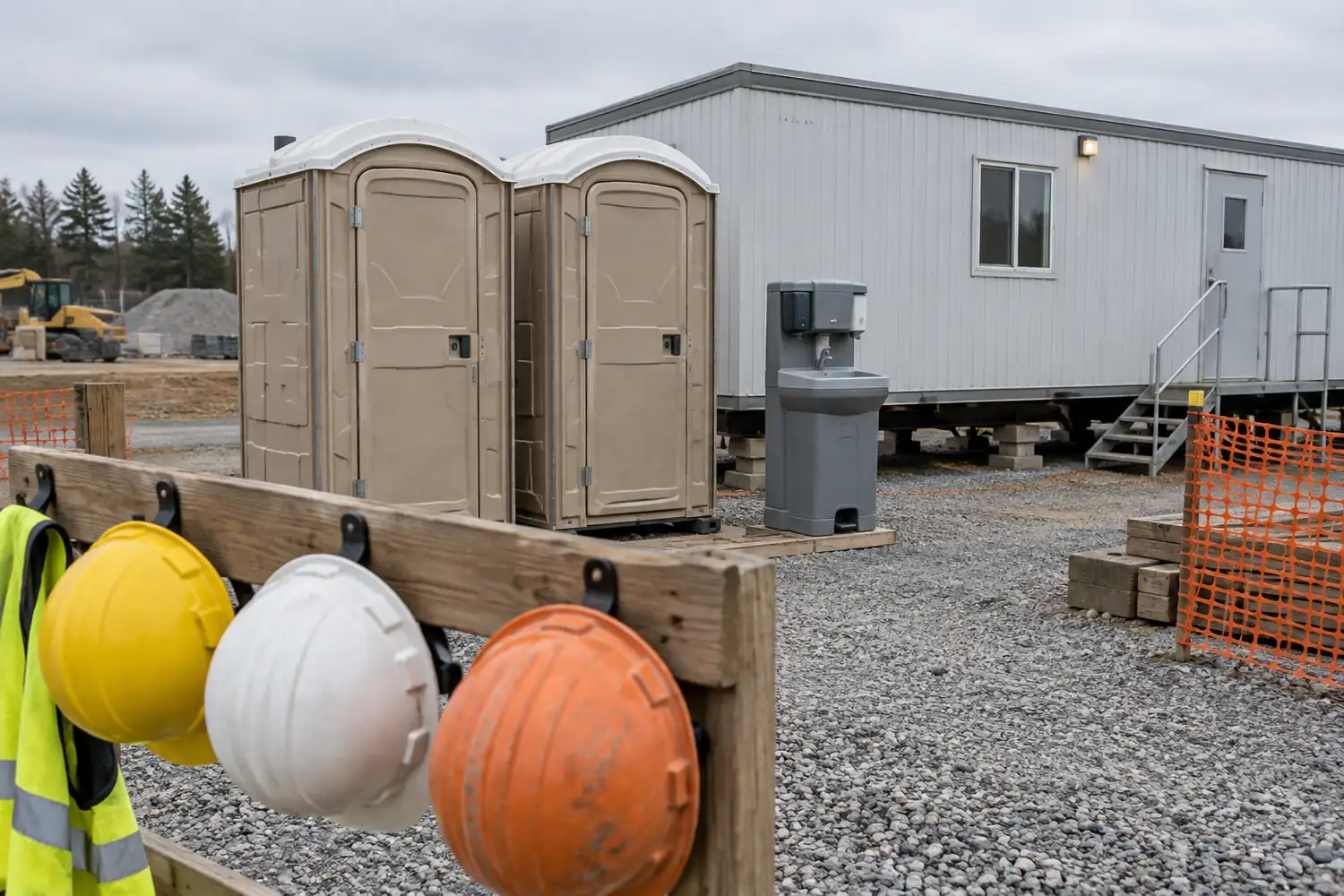
The OSHA table
29 CFR 1926.51(c)(1) says toilets shall be provided for employees according to this table:
| Number of employees | Minimum number of facilities |
|---|---|
| 20 or less | 1 |
| 20 or more | 1 toilet seat and 1 urinal per 40 workers |
| 200 or more | 1 toilet seat and 1 urinal per 50 workers |
A plain reading for planning
Rounding each ratio up to the next whole facility gives the following. The site safety lead decides how the table applies to a given project; this is a planning aid, not a compliance ruling.
| Crew | Seats and urinals |
|---|---|
| 1 to 20 | 1 toilet |
| 21 to 40 | 1 seat and 1 urinal |
| 41 to 80 | 2 seats and 2 urinals |
| 81 to 120 | 3 seats and 3 urinals |
| 121 to 160 | 4 seats and 4 urinals |
| 161 to 199 | 5 seats and 5 urinals |
| 200 | 4 seats and 4 urinals |
| 201 to 250 | 5 seats and 5 urinals |
At 200 workers the table switches to one of each per 50, which gives fewer facilities than at 199, so confirm the reading with the safety lead. Many standard units contain both a seat and a urinal, so one such unit covers one pair.
Other parts of the rule
- Temporary field conditions. Paragraph (c)(2) requires provisions so that at least one toilet facility is available.
- Sites without a sewer. Paragraph (c)(3) requires privies that will not contaminate water, chemical toilets, recirculating toilets or combustion toilets, unless local codes prohibit them. A rented portable toilet is a chemical toilet.
- Mobile crews. Paragraph (c)(4) says the toilet requirements do not apply to mobile crews that have transportation readily available to nearby toilet facilities.
Washing facilities
Paragraph (f)(3) says lavatories shall be made available in all places of employment. The exception covers mobile crews and normally unattended work locations whose employees have transportation readily available to nearby washing facilities. Paragraph (f)(1) adds washing facilities near the worksite for employees applying paints, coatings, herbicides or insecticides, or doing other work where contaminants may be harmful, equipped so they can remove those substances. All washing facilities must be kept sanitary. A hand-wash station is the usual way to meet the lavatory rule on a site without plumbing.
Accessible units on job sites
The 2010 ADA Standards exempt portable toilets provided exclusively for construction personnel. A site with a sales office, public walkway or visiting clients should plan an accessible unit.
Before the first delivery
Record the crew count used, the unit locations and the service day with the project safety file, and revisit them when the crew grows or a new phase starts. For recurring placements, see monthly and long-term rentals.